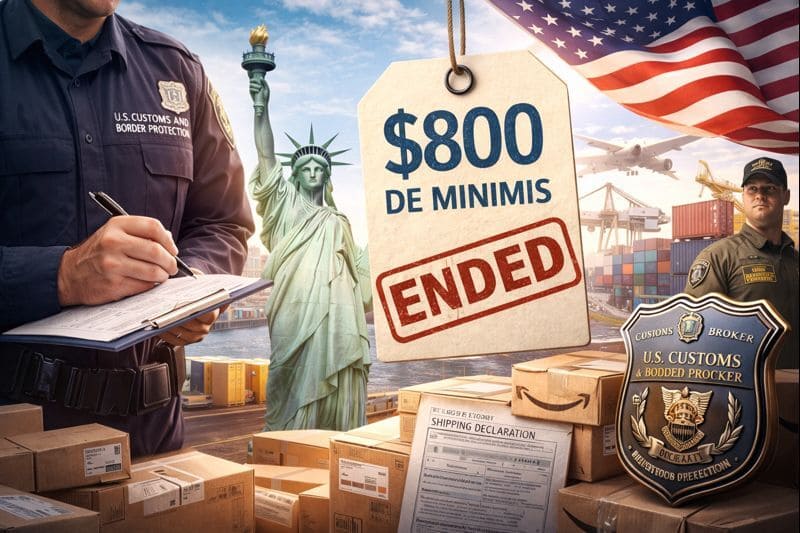
On August 29, 2025, the United States officially ended the de minimis regime that allowed duty-free entry for parcels valued under $ 800 with simplified customs clearance (Section 321). Now, even small commercial shipments must undergo full customs processing and pay applicable duties.
For global e-commerce, this means higher landed costs, new bureaucratic layers, and stricter data requirements.
What Changed
Exemption canceled. All commercial imports—even as low as $ 20—must now be filed as formal entries.
Legal basis. The change was enacted by a Presidential Proclamation on July 30, 2025, and took effect on August 29. U.S. Customs and Border Protection (CBP) confirmed readiness to enforce it in advance.
Context.The $ 800 threshold, set in 2016 under the Obama administration (TFTEA), was originally meant to boost cross-border trade. The repeal closes a regulatory loophole and tightens control over import flows.
Who Is Affected
Exporters from Europe, the U.K., and Asia shipping to the U.S. via courier or postal networks.
E-commerce sellers using small FBA/FBM replenishments or direct-to-consumer (DTC) models.
Operators relying on Section 321 / Type 86 entry programs — now discontinued. Full declarations and, in many cases, customs bonds and brokers are required.
Financial Impact
Higher landed cost. Every parcel now incurs customs duty (based on the HTS code) plus broker or carrier fees. For many consumer goods, landed-cost increases of 15−30% are typical.
Example. A $ 700 batch of accessories previously entered duty-free. Now the importer pays a 15% duty ($ 105) + $ 50 broker fee = $ 155 extra. Across 1,000 shipments per month, that’s +$ 155,000 in new expenses.
Product mix pressure. Low-margin SKUs may become unprofitable, forcing a re-evaluation of unit economics. Some items may recover viability as U.S. retail prices adjust in the medium term.
Operational Consequences
Data accuracy. Each item now requires a 10-digit HTS code and verified country of origin. Errors risk fines or delays.
Documentation. More formal entries and frequent bond requirements.
Logistics. Major carriers introduced transitional surcharges; some experienced delays in August-September.
What Businesses Should Do
Recalculate landed costs — include duties and brokerage fees per SKU.
Filter catalog — keep items with sustainable margins.
Consolidate shipments — optimize box composition and routes to cut per-unit costs.
Strengthen compliance — ensure product classification and origin data are correct.
Our Experience
We have already adapted our workflows:
— tightened product and brand selection;
— updated packaging standards;
— expanded shipment documentation;
— integrated duties and fees into cost models.
— updated packaging standards;
— expanded shipment documentation;
— integrated duties and fees into cost models.
Conclusion
The end of de minimis is a major shock to international e-commerce, but not a dead end. The U.S. remains the world’s largest market. Companies that move fast—by re-calculating economics, improving classification, and restructuring logistics—will not only survive but strengthen their positions.